
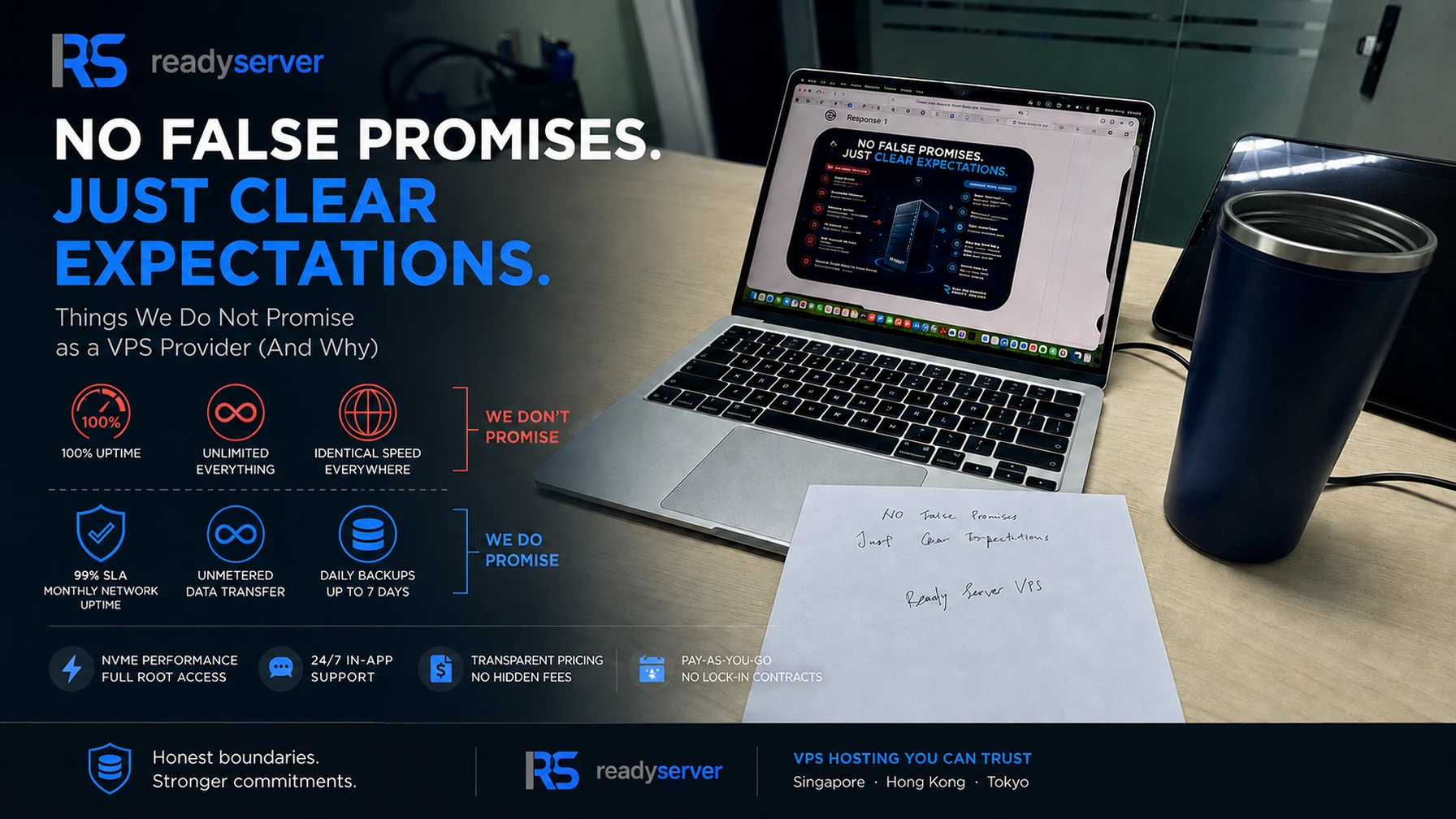
Things We Do Not Promise as a VPS Provider (And Why)
Why We Wrote Down What We Won’t Promise
Most hosting marketing is a list of promises: fastest, unlimited, 100% uptime, always-on. The problem is that some of those promises cannot be kept by anyone — and a provider willing to make them is telling you something about how it will treat you later.
At Ready Server Pte Ltd, we would rather earn trust the durable way: by being precise about what we commit to and honest about what we deliberately do not. Here are the things we will not promise, and the reasoning behind each one. Every “no” comes with what we do offer instead.
1. We Do Not Promise 100% Uptime
No infrastructure on earth is immune to hardware failure, maintenance, or upstream events, and any provider claiming a literal 100% has quietly redefined the word.
What we do instead: Our Service Level Agreement commits to 99% monthly network uptime for the VPS service — a firm floor we will stand behind in writing — and in day-to-day operation we work to push actual availability well beyond it, toward 99.9% or higher. Just as important is what happens when we fall short: because our service is billed hourly, when our backend network is down your billing pauses until it is restored. You are not charged for our downtime. A commitment we honour on your invoice is worth more than a marketing number we cannot.
2. We Do Not Promise “Unlimited” Anything
“Unlimited bandwidth,” “unlimited resources” — these phrases survive only until you read the fine print. Physical infrastructure has finite capacity, and pretending otherwise sets a false expectation.
What we do instead: We offer unmetered data transfer — no volume cap and no per-gigabyte overage — delivered from a shared, high-capacity network and allocated dynamically under a fair use policy. As we explained in why we provide unmetered data transfer instead of quotas, that is a genuinely generous model, and naming its real boundaries (shared capacity and fair use) is exactly what makes it trustworthy.
3. We Do Not Promise Identical Speed to Every Network on Earth
Your VPS lives in a data centre; your users live behind hundreds of independent ISPs across the world. Between the two runs the public internet, which no hosting provider owns or controls.
What we do instead: We run fast, well-connected infrastructure in Singapore, Hong Kong, and Tokyo, optimise routing at our edge, and help you choose a location close to your audience — because, as we cover in how server location affects website speed, proximity is the single biggest lever we can pull. What we will not do is guarantee a specific latency to a network we do not operate.
4. We Do Not Promise to Run Your Server for You (on Unmanaged Plans)
A VPS with full root access is powerful precisely because it is yours to control. That same control means the operating system, applications, updates, and security configuration inside the server are your responsibility on an unmanaged plan.
What we do instead: We keep the platform — network, host, and hardware — healthy and available, and our 24/7 in-app support chat helps at that boundary and beyond it wherever we reasonably can. But we will be clear about where our responsibility ends and yours begins, rather than implying we silently manage things we do not. Our article on managed vs. unmanaged VPS hosting explains the distinction in full.
5. We Do Not Promise Our Backups Replace Your Own
Backups are the ultimate safety net, and exactly how they work is the kind of thing a provider should be precise about rather than vague.
What we do: For disaster recovery, we take daily backups of your VPS and retain them for up to 7 days. If something goes badly wrong at the infrastructure level, that gives us a recent point to restore from.
What we do not promise: that this disaster-recovery rotation is a substitute for your own backups. A rolling 7-day snapshot is built for infrastructure-level recovery — it is not a guarantee of granular, point-in-time restoration of an individual file or database whenever you want it. Because you keep full root access, the best practice is still to maintain your own backups as well; our guides on backing up and restoring a Linux VPS and the 3-2-1 backup rule show how. Two safety nets are better than one.
6. We Do Not Promise to Be the Cheapest
There is always a cheaper number somewhere, usually made possible by oversold hardware, hidden fees at renewal, or bandwidth quotas that bite later.
What we do instead: We compete on predictability and value — transparent pricing with no hidden fees, unmetered transfer, NVMe performance, pay-as-you-go billing, and no lock-in contracts. The right question is not “what is the lowest sticker price?” but “what will this actually cost me, and what will it actually deliver?”
What We Do Promise
Every “no” above exists to protect a short list of things we are prepared to stand behind:
- Transparent pricing — no hidden fees, no surprise overage charges
- Unmetered data transfer on a shared, high-capacity network, under a clear fair use policy
- A real, written SLA — 99% monthly network uptime, with hourly billing that pauses during backend network downtime so you never pay for our outages
- Daily disaster-recovery backups retained for up to 7 days
- NVMe performance, full root access, and instant deployment
- 24/7 in-app support chat that is honest about where responsibility sits
- Pay-as-you-go billing with no lock-in contracts — cancel any time and billing stops
Conclusion: Credibility Is Built on the Honest “No”
It is easy to promise everything. It is far more useful — and far rarer — to tell a customer exactly what will and will not happen. The boundaries in this article are not hedges; they are the reason the commitments around them are believable.
If that is the kind of provider you want behind your infrastructure — one whose promises are worth exactly what they say — explore ReadyServer VPS hosting, read our SLA in full, or talk to our team. We would rather under-promise and over-deliver than the other way around.